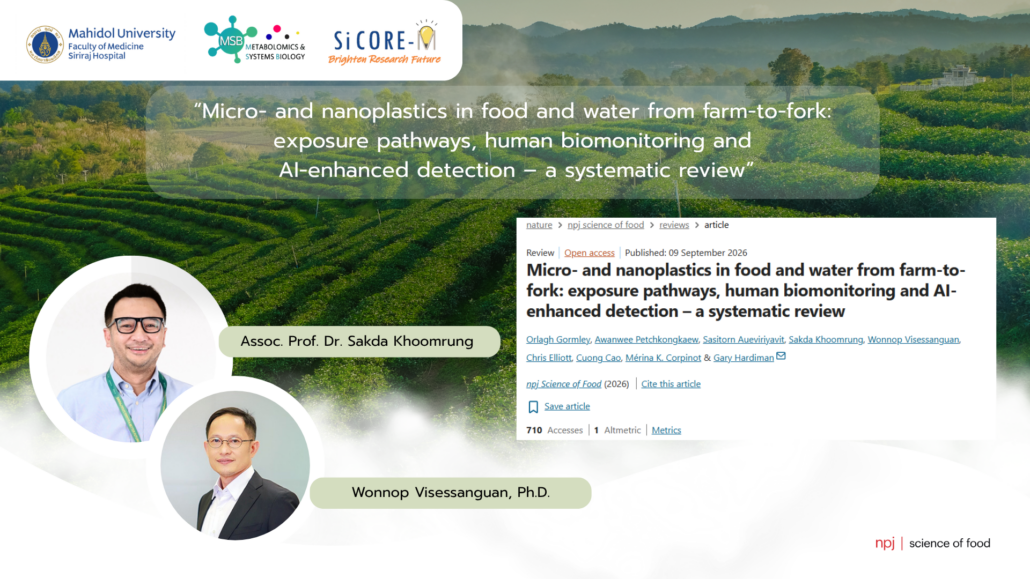

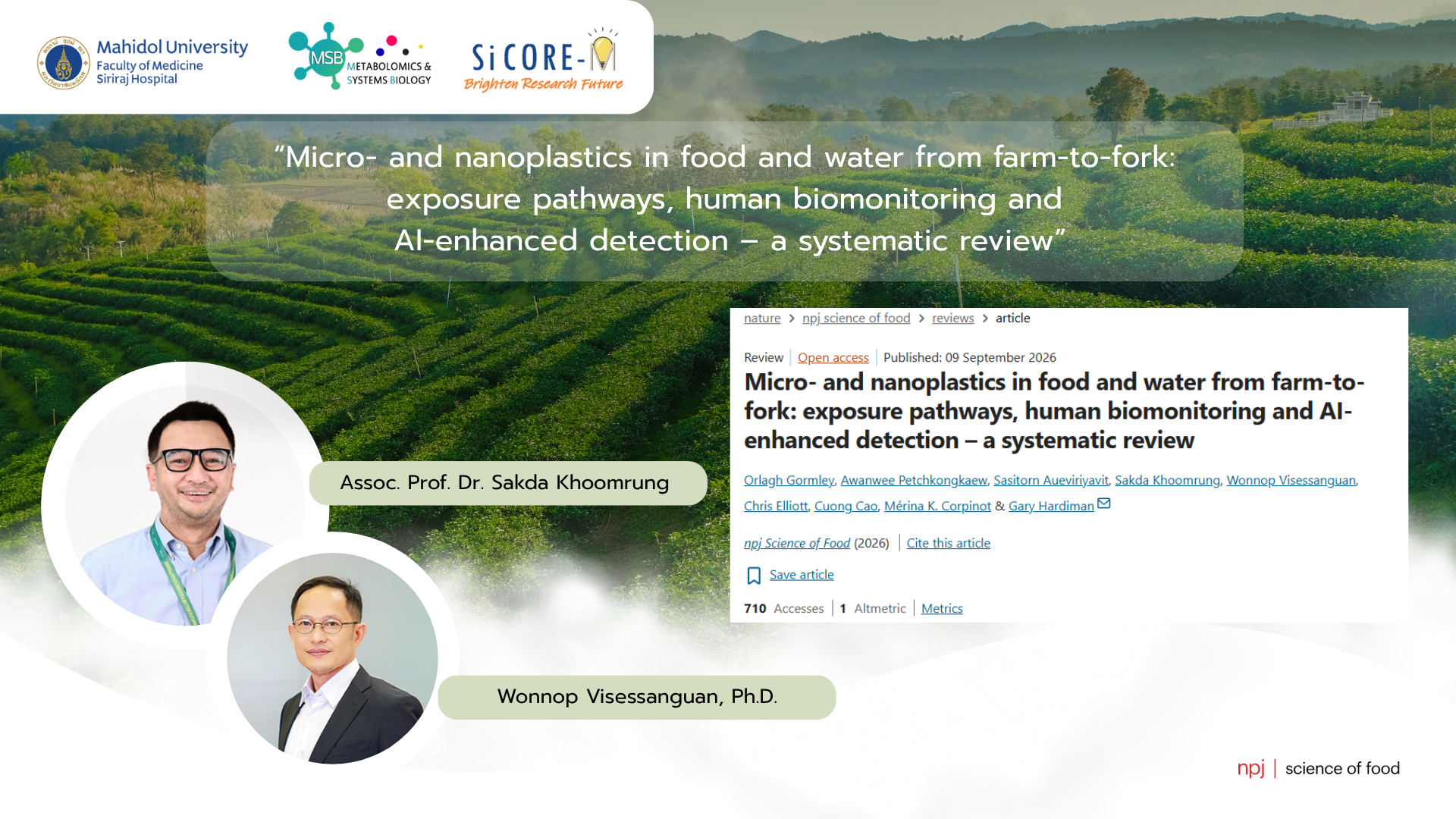
Congratulations to Assoc. Prof. Dr. Sakda Khoomrung from SiCORE-MSB & SiMPC and Lecturer Dr. Wonnop Visessanguan from SiMPC, Faculty of Medicine Siriraj Hospital, Mahidol University, on their latest publication in npj Science of Food (September 9, 2026):
Congratulations to Assoc. Prof. Dr. Sakda Khoomrung from SiCORE-MSB & SiMPC and Lecturer Dr. Wonnop Visessanguan from SiMPC, Faculty of Medicine Siriraj Hospital, Mahidol University, on their latest publication in npj Science of Food (September 9, 2026):
“Micro- and nanoplastics in food and water from farm-to-fork: exposure pathways, human biomonitoring and AI-enhanced detection – a systematic review”
Read the article:
https://www.nature.com/articles/s41538-026-01054-5
Study Highlights
This systematic review brings together evidence on micro- and nanoplastics (MNPs) across the food and water chain, from farm to fork, covering exposure pathways, human biomonitoring, and emerging AI-enhanced detection technologies. The review highlights evidence of dietary exposure, the presence of MNPs in human biological samples, and the growing use of Raman spectroscopy, FTIR, machine learning, and deep learning to improve detection and characterization.
Why It Matters
MNPs are emerging contaminants of concern across the food and water chain. However, differences in analytical approaches continue to make exposure assessment challenging. The review highlights how standardized analytical methods and AI-assisted technologies could strengthen monitoring, risk assessment, and food safety strategies.
Key Takeaway
By connecting evidence from food and water exposure, human biomonitoring, and AI-based analytical technologies, this review provides an integrated perspective on MNP exposure and detection. The findings underscore the need for standardized methods, robust validation, and continued research to support more reliable food safety monitoring and future regulatory development.
News & Related Events