Sirindhorn School of Prosthetics and Orthotics (SSPO)
Overview Menu
- Required Documents for Application
- Program Overview
- Curriculum Structure
- Introducing our courses
- General Education Courses
- Professional Core Courses
- Free Elective Courses
- Tuition and Fees
- Admission Requirements
- How to Apply
Required Documents for Application
- A completed application form
- Transcript
- Scanned copy of passport profile page (Passport must be valid for over two years before arriving in Thailand) or national ID if passport is not available.
- Letter of intention to study in our program
- One of English test result valid not over 2 years and reached the following admission requirement scores.
- One of Mathematics test result valid not over 2 years and reached the following admission requirement scores.
- Documents required for candidates holding the ISPO Category-II certificate.
- Scanned copy of ISPO Category-II certificate with registration number
- Transcript from previous institute, indicating the details of each subject and the score must be over than 60% or grade C.
– If the score is lower than 60%, please attach the confirmation letter of grading guideline from your institutes to inform that your score is equivalent to grade C.
– The curriculum details of the previous school is required for credit transfer approval by Mahidol University if your institute is not on our P&O school list below:-
- Sri Lanka School Of Prosthetics and Orthotics – SLSPO
- Vietnamese Training Centre for Orthopedic Technologist – VIETCOT
- Jakarta School for Prosthetics and Orthotics – JSPO
- Cambodia School of Prosthetics and Orthotics – CSPO
- Pakistan Institute of Prosthetic and Orthotic Sciences – PIPOS
- Department of Prosthetics and Orthotics, University of Rwanda
- Mobility India – MI
- Bangladesh Health Professions Institute – BHPI
-
- The attached photo file with clear background, recently taken within the last 6 months and the size should not exceed 25 MB.
Program Overview [Objectives and Learning Outcomes]
- Objectives of the Program
To develop graduates with the following competencies:- Possess the knowledge in prosthetic and orthotic sciences, biomechanics, medical sciences, other related sciences to the provision of prosthetic and orthotic treatment.
- Demonstrate the skills involved in prosthetic and orthotic treatment in accordance with international professional standards.
- Express enthusiasm for personal and professional development by utilizing technology and evidence to promote sustainable lifelong learning skills.
- Demonstrate an ethical, moral, and proper attitude toward the prosthetic and orthotic profession.
- Collaborate and communicate with multidisciplinary teams, including patients, and adapt to the diversity of global society.
- Program Learning Outcomes (PLOs)
At the end of the program, successful students will be able to:
PLO1 Develop comprehensive treatment and follow-up plans for prosthetics and orthotics by integrating knowledge and current evidence that is relevant to individual circumstances and adheres to professional standards.
PLO2 Implement the prescribed treatment plan by conducting the necessary procedures to deliver the international professional standards prosthetic and orthotic services and in response to users’ requirements.
PLO3 Demonstrate core prosthetic and orthotic professional behaviors and a commitment to lifelong learning.
PLO4 Communicate effectively with patients, healthcare professional and the public properly to the role of the prosthetics and orthotics profession.
PLO5 Demonstrate ethical behavior according to the Siriraj identity, including altruism, integrity, and responsibility.
PLO6 Collaborate with others in the field of prosthetics and orthotics profession to contribute to the goals of healthcare team. - Career Opportunities of the Graduates
- Prosthetist and orthotist who can practice internationally
- Instructors in international prosthetic and orthotic schools
- Prosthetics and orthotics entrepreneurs
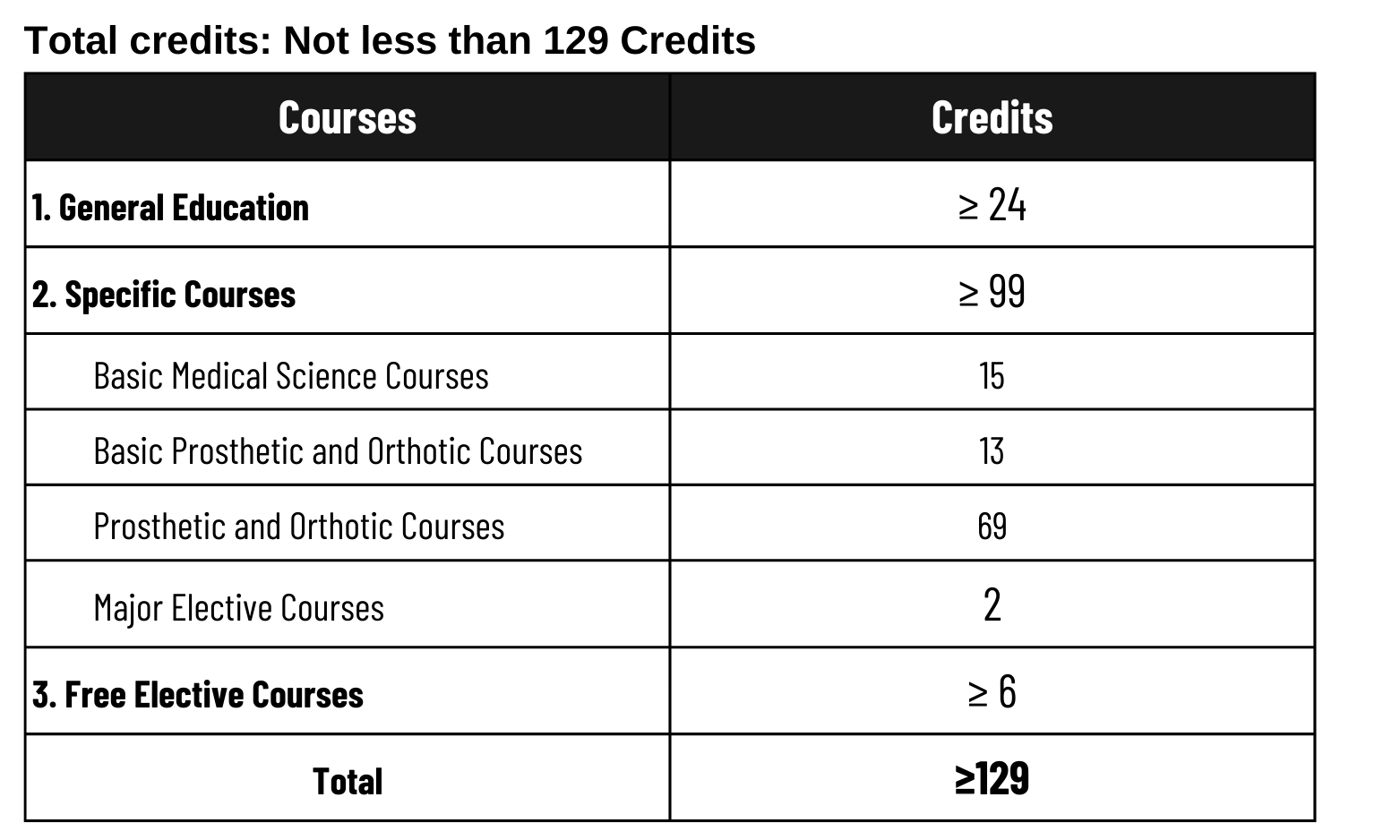
Curriculum Structure
Online document: N/A
Introducing our courses
ICGE 104 Academic Writing and Research
An introduction to the academic writing process through the development of the writer’s criticism through sentencing, structure, and rhetorical devices; focusing on strategies for using and integrating researched sources; methods to compose well-structured essays based on themes relevant to the world today
ICGE 105 Public Speaking
Fundamentals of key skills for confident and efficient public speaking through a series of prepared and unprepared speeches; introducing and applying techniques to inform/persuade audiences; utilizing Academic Writing and Research I and II to create and deliver speeches to create a professional standard
ICGE 126 Introduction to Thai Language and Culture
Fundamental vocabularies and structures for various communicative situations in everyday use and introduce basic aspects of Thai culture
ICGE 127 Elementary Thai I
Listening and speaking skills on the following topics: introducing oneself one’s friend and family, basic food and drink ordering, places, directions, transportation, buying tickets, clothing items, colours, and sizes, bargaining, counting and using classifiers, reading and writing Thai consonants, vowels placed after, before, above, and below the consonants, Thai numbers, live and dead syllables
ICGE 128 How to Know What Is Good? Moral Reasoning and Behavior
A survey of philosophical, psychological and scientific contributions to the understanding of moral values and agency; hands-on construction, scrutiny and analysis of ethical argument regarding burning issues in applied ethics
ICGE 190 Scientific Research and Presentation
Scientific method of discovery; developing a hypothesis and testing, interpretation of the results; synthesis of different published data to answer a single hypothesis; proper format for presenting papers in public and in a scientific forum; practical sessions and participation in scientific seminars included
ICGE 133 Leadership and Change for Global Society
Concepts and practices for leadership development; developing leadership skills and challenges of change in a global society; the need, vision, initiation for change, teamwork and collaboration for the efficient management
ICGE 141 Fundamental Entrepreneurship
Creating new businesses, capturing new markets, enhancing organizational effectiveness, entrepreneurship theories and frameworks, practices of promoting and managing start-ups, the life-cycle of an entrepreneurial venture, concept implementation, entrepreneurial pathway, customer analysis, integrated marketing, funding, securing and managing capital, human capital management under the disruptive environment
Elective Course
ICGE 113 Create Thinking Through Art and Design
Combining hands-on studio experiences with demonstrations, lectures and discussions; developing creativity and gaining confidence in communicating one’s own unique vision; exploring a variety of art and design mediums; understanding the elements of the visual language; implementing the creative process and creative thinking to develop individual solutions to open-ended problems
ICGE 117 Drawing as Creative Expression
Developing creativity and cognitive learning; utilizing visual communication, design and art principles; experiencing multiple tools, techniques, medium, experimental mark-making; research, analysis, observation, gesture, principles and elements of design and composition; examining, analyzing, observing and reinterpreting the human figure, plant and still life forms; research, interpreting, evaluating, analyzing contemporary artists; personal evaluation; personal expression
ICGE 123 Biotechnology: from Science to Business
Biotechnology, bioethics, and the law, biotechnology and the regulatory framework, genetic testing, patenting life, biobanks and modern genomics research, genetically modified organisms, human and animal testing; bioterrorism, biological weapons laws, bio-prospecting, pharmaceutical pricing, the future of the human beings and post-humanism
ICGE 125 Critical Thinking
Basic formal tools from sentential and predicate logic; Logical structures of the primary classes of arguments used in the everyday contexts of life; Analysis of arguments within these classes for their strengths and weaknesses; Common fallacies in reasoning, including reasoning involving determining probabilities; Construction of good arguments using principles of informal reasoning
ICGE 136 Skills in Dealing with People Across Culture
The development of skills in dealing with people across cultures, identity formation and conflict; ethics and the moral behaviors; values and communication across cultures; culture and tourism; culture and the work motivation; culture in educational institutions
ICGE 142 Personal Finance Management
The personal finance administration and investment, financial planning process, financial statements and budgets, tax preparation; the cash and savings management, investment planning, investing in stocks and mutual funds, making automobile and housing decisions; life insurance, protecting the property, retirement planning
ICGE 144 Career Preparation In Globalized World
Trends in national, regional and international job markets; self-assessment on career options; career plan creation; principles in business communication; job search process and tools; resume, cover letters; interview preparation and simulation; dimensions of culture
ICGE 162 Understanding and Visualizing Data
Analyzing the basic information to the data analytics; roles and examples of the data- driven decision making; technology landscape; data kinds and types; data sources and collection techniques; the data storage and standard formats; the data processing workflow; summary of the data; different types of visualization; data visualization tools
ICGE 171 Personal Life and Well Being
Understanding the health as a continuous process and can be changed at any time depending on the choices we make; exploring the current challenges facing young people of today; evaluating on how they affect health and healthful behavior; what individuals can do to navigate these challenges to arrive at their goals for the future
ICGE 172 Body Fitness
A comprehensive course in one or more exercise techniques: strength/resistance, cardio, plyometric, stretching, high-intensity interval training, and calisthenics; to maintain health and wellness
ICGE 173 Discover Dance
A dance based course of current forms and techniques in one or more categories: African/Jazz, Worldwide Dances/Latin Dances, Professional Performance Dance, Modern Dance, Hip-hop/Funk
ICGE 174 Mind and Body
A course stressing meditation postures, techniques, movement, and breathing to achieve positive mental state
Basic Medical Science Courses
SIAN221 Anatomy
Gross anatomy of human body regarding structure, function and relationships between various structures of head, face and neck, upper extremity and brachial plexus, and the thoracic and abdominal wall including surface anatomy and practice of cadaver dissection
SIPS 251 Physiology
Normal functions and mechanism of body systems such as musculoskeletal, circulatory, respiratory, endocrine, urinary, digestive, metabolism and body temperature regulatory systems
SIPO 111 Basic Biomechanics
Basic mathematics; linear and angular kinematics, linear and angular kinetics and mechanical load on the human body
SIPO 214 Applied Biomechanics
Application of kinetics and kinematic on human movement, posture and balance, biomechanics of bone, skeletal muscle, biomechanics of lower limb, upper limb and spine, biomechanical application of lower limb, upper limb and spinal in prosthetic and orthotic devices, ergonomics
SIPA 212 Pathology
Causes, mechanisms and basic pathologic changes of cell and tissue of human body suffering from diseases; pathology of organ systems that are important and/ or commonly found; principle of laboratory investigation; clinical microscopic, clinical chemistry, serology, hematology, molecular clinical pathology
SIPC 212 Psychology Practice for Persons with Physical Disabilities
Basic psychology; clinical psychology; psychological reaction to loss; persons with physical disabilities approach and communication
SIRM 212 Rehabilitation Medicine
Gross rehabilitation medicine and teamwork; goals and principles of rehabilitation; rehabilitation; assessment; quality of life; activities of daily living; introduction to physical therapy, occupational therapy; manual muscle testing, range of motion; rehabilitation of common disease/disorders
Basic Prosthetics and Orthotics Courses
SIPO 163 Introduction to Prosthetics and Orthotics
Principle of prosthetics and orthotics education; terminologies and definition in prosthetics and orthotics; role of prosthetist and orthotist; development in prosthetics and orthotics and education in Thailand; national and international prosthetic and orthotic services
SIPO 265 Prosthetic and Orthotic Technical and Safety Skills
Basic knowledge and practical skills related to prosthetics and orthotics; awareness of health and safety; basic skills through the safe use of hand tools, portable power tools, machines, and personal protective equipment (PPE); properties of common materials used in prosthetics and orthotics, material sciences; practice activities involve materials and prosthetic and orthotic technical skills
SIPO 266 Clinical Gait Analysis
Basic knowledge and practical skills related to prosthetics and orthotics; awareness of health and safety; basic skills through the safe use of hand tools, portable power tools, machines, and personal protective equipment (PPE); properties of common materials used in prosthetics and orthotics, material sciences; practice activities involve materials and prosthetic and orthotic technical skills
SIPO 365 Research in Prosthetics and Orthotics
Introduction to research methodology; research problems; literature review; research design; statistics in research; research example in prosthetics and orthotics; research proposal and final report structure; research presentation; ethics in research; writing a project proposal; collecting data; analyzing data; presenting a project; writing a final project report
SIPO 365 Research in Prosthetics and Orthotics
Introduction to research methodology; research problems; literature review; research design; statistics in research; research example in prosthetics and orthotics; research proposal and final report structure; research presentation; ethics in research; writing a project proposal; collecting data; analyzing data; presenting a project; writing a final project report
Prosthetics and Orthotics Courses
SIPO 271 Pedorthic Science
A review of anatomy, biomechanics, pathology and deformity of foot; variation of material used in pedorthics; patient assessment for prescription principle; pedorthic management including using prefabricated devices, designing, manufacturing, fitting and offloading of custom-made orthotic appliances construction principle of medical grade footwear; footwear modification; clinical consideration; existing pedorthic appliances and theirs impact on human posture and gait
SIPO 272 Pedorthic Practice
Clinical practice and technical aspects on pedorthic appliances; patient assessment; biomechanical assessments and gait analysis; treatment planning; casting and foaming technique; positive cast modification methods; manufacturing of custom-made foot orthotic; modification of pre-fabricated footwear; fitting and adjustment; existing outcome and impact of pedorthic modalities
SIPO 278 Ankle Foot Orthotic Science
Biomechanics of lower leg; pathology of lower leg; physical assessment and gait analysis; biomechanics of ankle foot orthosis; variation of materials; prescription principle of ankle foot orthosis; principle of lower limb orthosis; variation of an ankle foot orthosis prescription principle of ankle foot orthosis; outcome measurement and method
SIPO 279 Ankle Foot Orthotic Practice
Clinical practice and technical aspect of ankle foot orthosis;assessment and gait analysis; casting technique for ankle foot orthosis; fabrication and joint setting techniques; fitting technique for ankle foot orthosis; the ankle foot orthosis trial for walking; outcome analysis and clinical problem solving
SIPO 283 Ankle Disarticulation and Transtibial Prosthetic Science
Principles of rehabilitation and prosthetic management of ankle disarticulation and transtibial amputation; functional deficits and psychosocial impact; pre-and post-operative care; biomechanical principles; structures and components of prosthesis and clinical reasoning; manufacturing process; physical assessment; casting; modification; bench alignment setting, fitting and gait analysis, cosmetic finishing; gait training; patients education
SIPO 284 Ankle Disarticulation and Transtibial Prosthetic Practice
Clinical and technical aspects of ankle disarticulation and transtibial amputation prosthetic management; systematic approach to patient assessment, application of biomechanics to prosthetic component selection; prosthetic manufacturing process; casting; modification; bench alignment setting, fitting and gait analysis, cosmetic finishing; gait training; patients education; problem solving and clinical reasoning
SIPO 371 Knee Ankle Foot Orthotics
A lower limb assessment and deformities of hip, knee, ankle; clinical evaluation for orthotic prescription, orthotic adjustment, treatment plan; principles of knee ankle foot orthotic treatment; material and component selection; biomechanical approach; knee ankle foot orthotic fabrication, fitting, outcome measurement, clinical problem solving; complication of knee ankle foot orthotic fitting, A clinical practice of lower limb assessment; deformities of knee, ankle; evaluation for orthotic prescription, orthotic adjustment, treatment plan
SIPO 372 Upper Limb Orthotics
A review of anatomy, biomechanics, pathologies related to upper limb; upper limb orthotic prescription principles and interventions; variation of upper limb orthoses; materials used in upper limb orthoses; patient assessment, measurement and casting, plaster modification, fabrication, fitting of upper limb orthoses; outcome measurement and clinical problem solving
SIPO 378 Cranial and Spinal Orthotic Science
A review of anatomy, biomechanics, pathologies related to cranial and spine; multidisciplinary team approach to cranial and spinal problems; exercise for spinal problems; prescription consideration; cranial remolding orthotic principle; variation of cranial remolding orthosis; spinal orthotic principle, variation of spinal orthoses; orthotic management for patient with scoliosis; x-ray examination; biomechanical principle of orthotic design; patient communication and assessment; measurement and casting, plaster modification, fitting and modifying the cranial orthoses and spinal orthoses, outcome analysis and clinical problem solving
SIPO 379 Cranial and Spinal Orthotic Practice
Clinical demonstration and practice of cranial remodeling and spinal orthotic management for patient with cranial and spinal disorders; patient assessment; prescription and orthotic design for scoliosis patient including material selection, casting, plaster modification, fabrication, fitting, problem solving and outcome evaluation; cranial remodeling orthotic and spinal orthotic adjustment; patient education; caregiver and family education in the use and care of orthotic devices; patient communication
SIPO 385 Knee Disarticulation and Transfemoral Prosthetic Science
Physical and functional deficits related to the knee disarticulation and transfemoral amputate; pre- and post-operative prosthetic care; basic principle and biomechanical concept of the knee disarticulation and transfemoral prosthesis; composition of prosthesis, variation of design, materials and components; prosthetic prescription considerations; patient assessment; principles of manufacturing, alignment setting, fitting and adjustment, finishing of knee disarticulation and transfemoral prostheses; prosthetic gait analysis; knee disarticulation and transfemoral prosthetic gait training; patient education; outcome measurement for patients with knee disarticulation and transfemoral prosthesis
SIPO 386 Knee Disarticulation and Transfemoral Prosthetic Practice
Clinical and technical aspects on knee disarticulation and transfemoral amputees; an assessment and prescription based on the biomechanics principle; prosthetic socket design, components and materials selection; casting, rectification, fabrication and alignment, fitting, finishing; prosthetic problem analysis, solution
SIPO 387 Upper Limb Prosthetics
Physical, mental and functional deficits related to the upper limb amputee; congenital upper limb deficiency; pre- and post-operative prosthetic care; basic principle and biomechanical concept of the upper limb prosthesis; clinical and technical aspects on upper limb amputees; composition of prosthesis, variation of design, materials and components; prosthetic prescription consideration; patient assessment; principles of manufacturing, alignment setting, fitting and adjustment, finishing of the upper limb prosthesis; patient education; outcome measurement for patients with upper limb prosthesis
SIPO 397 Fundamental of Clinical Reasoning
Clinical reasoning principles and impact on clinical practice; clinical reasoning process; critical thinking and clinical decision-making strategies; International Classification of Functioning, Disability and Health; evidence-based practice; patient and interprofessional communication; practice of case-based clinical reasoning and clinical problem solving
SIPO 398 Clinical Practice 1
A preparation to the clinical experience; an observation of prosthetic and orthotic services, patient approach under supervision and guidance; professional competence, health and safety, attitudes and ethical behavior, communication, interpersonal skills, and teamwork; an application of knowledge and prosthetic and orthotic technical skills to the prepared case under closed supervision; reviewing medical reports; performing and interpreting clinical assessments; treatment planning; implementation the treatment plan, manufacturing and fitting of the prosthetic and orthotic devices; reviewing and evaluating the result of the prosthetic and orthotic devices
SIPO 461 Wheelchair and Seating for Persons with Physical Disabilities
An introduction to the mobility, sitting posture, transfering, pressure sores, and the wheelchair service steps, cushion, and custom modified seating for the users; referral, assessment, measurement, casting, prescription, ordering, preparation or fabrication, fitting, user training, maintenance, repairs, and follow up
SIPO 485 Partial Foot and Hip Disarticulation Prosthetics
Physical and functional deficits related to the partial foot and hip disarticulation amputate; basic principle and biomechanical concept of the partial foot and hip disarticulation prosthesis; composition of prosthesis, variation of design, materials and components; prosthetic prescription considerations; patient assessment; principles of manufacturing, alignment setting, fitting and adjustment of partial foot and hip disarticulation prostheses; prosthetic gait analysis; partial foot and hip disarticulation prosthetic gait training; patient education; outcome measurement for patients with partial foot and hip disarticulation prosthesis; cosmetic finishing for partial foot prosthesis
SIPO 497 Clinical Practice 2
A continuous preparation to the clinical experience; an observation of prosthetic and orthotic services, patient approach under lower level of supervision and guidance; professional competence, health and safety, attitudes and ethical behavior, communication, interpersonal skills, and teamwork; an application of knowledge and prosthetic and orthotic technical skills to the complexed cases under supervised environment; reviewing medical reports; performing and interpreting clinical assessments; treatment planning; emphasizing evidence-based practice; implementation the plan, manufacturing and fitting of the prosthetic and orthotic devices; reviewing and evaluating the final devices; case discussion as a member of health care team
SIPO 498 Clinical Experience 1
An application of knowledge and skills into real practice; a clinical practice of the prosthetic and orthotic services to the real patient independently under a close supervision of clinical instructor at the internal collaboration training placement; A process of patient check-in until device delivery and follow up in the clinical service; the reimbursement of prosthetic and orthotic device; patient’s right and payment; workplace professionalism and independent work; communication and interpersonal skills, planning and time management; knowledge exchange from case study discussion; a written clinical report and a case presentation; a reflection of self-experience
SIPO 499 Clinical Experience 2
An application of knowledge and skills into real practice; a clinical practice of the prosthetic and orthotic services to the complexed case independently under a consult of clinical instructor at the internal or external collaboration training placement; A process of patient check-in until device delivery and follow up in the clinical service; the reimbursement of prosthetic and orthotic device; patient’s right and payment; professionalism and ethics consideration as a healthcare profession; communication and interpersonal skills, planning and time management; knowledge exchange from case study discussion; a written clinical report and a case presentation; a reflection of self-experience
Basic Prosthetics and Orthotics Courses
SIPO 476 Custom-Made Footwears
Anatomy and the structure of custom-made footwears; selection of materials, tools, and equipment specific to custom made footwears; variation of medical footwears; tracing, sewing, and manufacturing custom-made footwears; shoe fitting technique; shoe modification
SIPO 477 Orthotics for Charcot Foot
Anatomy and pathology relate to Charcot foot deformity; biomechanics relate to orthotic management for Charcot foot deformity; treatment options; materials and component of orthotic for Charcot foot deformity; patient assessment, treatment plan, orthotic design, fabrication and fitting; fitting evaluation and adjustment
SIPO 463 Clinical Research Instrumentation in Prosthetics and Orthotics
An introduction to clinical research instrumentation in prosthetics and orthotics; the outcome measurement in prosthetics and orthotics; motion measurement; load and pressure measurement; 3D motion analysis; metabolism and energy expenditure measurement; mechanical property testing; data analysis and interpretation
SIPO 464 Research Experience in Prosthetics and Orthotics
Formulating a research plan, data collection, assessment of data quality, data analysis, data interpretation, writing a report, and research presentation; executing the responsibilities of research in a professional and ethical manner
SIPO 465 Prosthetics and Orthotics in Community
Concepts of prosthetist and orthotist in community, schools and special centers for education; an ecological perspective in the schools and communities; applying evidence- based evaluations and services to school and community for occupational therapists; project writing, working in communities and creating community networking; manage projects to achieve the goals to promote the quality of life of the people in the community
Students have the option to pursue any course available at the undergraduate level, specifically international programs at Mahidol University or other educational institutions. Subject to the permission of the SSPO’s Undergraduate Education Committee and in compliance with the regulations of Mahidol University.
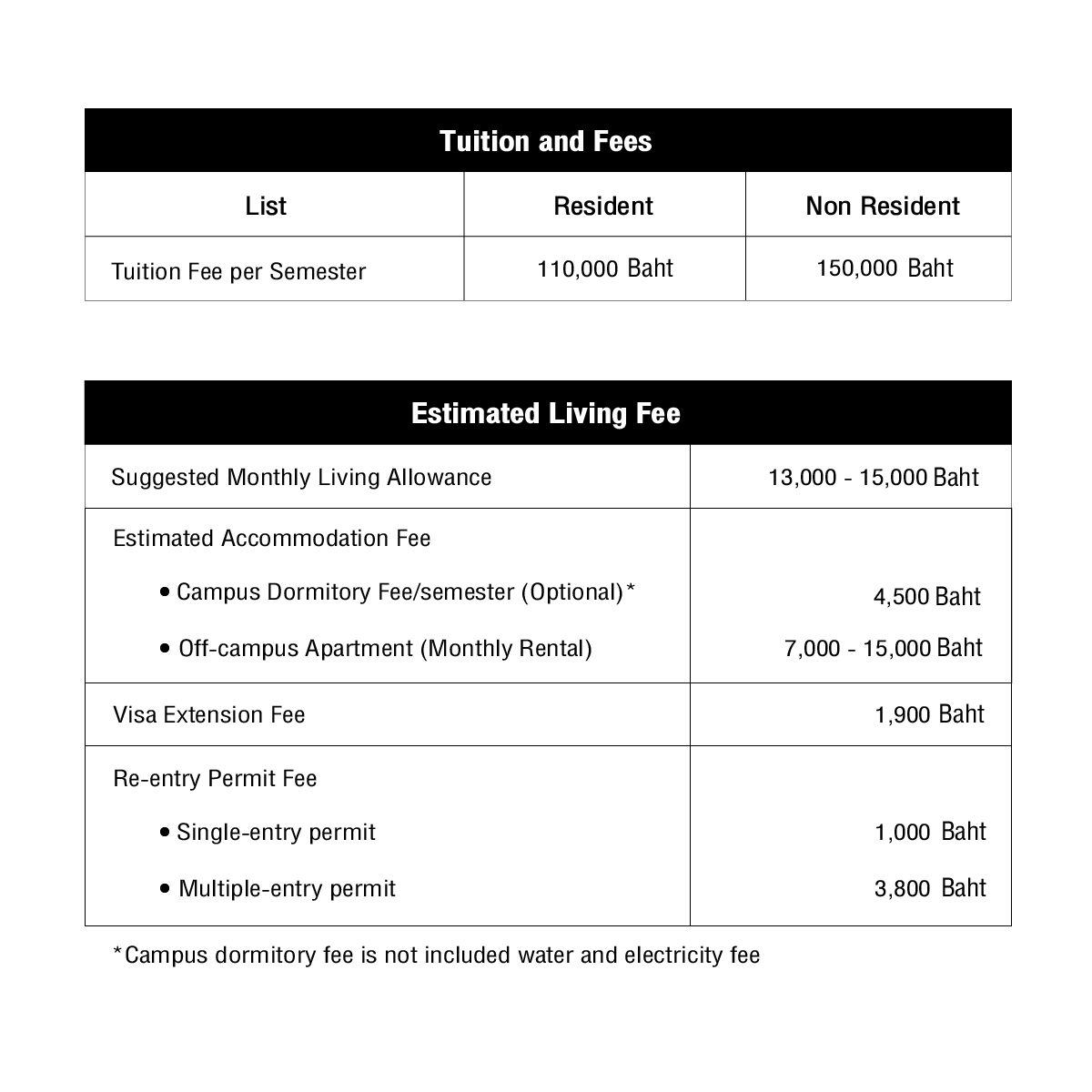
Tuition and Fees
Admission Requirements
1) Graduate from high school or equivalent
2) Achieve one of the English test scores:
TOEFL (iBT) ≥69
IELTS (Academic) ≥ 6.0
PTE (Academic) ≥ 5.0
For non-native English speaking applicants
TOEFL (iBT) ≥69 and writing 22
IELTS (Academic) ≥ 6.0 and writing ≥ 6.0
PTE (Academic) ≥ 5.0 and writing ≥ 5.0
3) Achieve one of the Mathematics test scores:
New SAT (Mathematics) ≥ 600
ACT (Mathematics) ≥ 25
How to Apply
Students interested in applying for enrollment in the Bechelor program (Intenational) must apply directly to SSPO. Visit the Application form download and follow the application instructions to apply online. The admission period will be announced on the SSPO website. The admission process involves the following steps:
Step 1: Complete the admission of the program.
Step 2: Announcement of a qualified candidate and interview exam
Step 3: Announcement of Qualified Student
The qualified students will received a notice email from sisspoedu@mahidol.edu
Step 4: Student check-in at SSPO
The successful student requires checking-in and attending orientation program at Sirindhorn School of Prosthetics and Orthotics, Faculty of Medicine Siriraj Hospital, Mahidol University.
Step 5: Enrolling the course and paying for the tuition fee
Student require paying the tuition fee when the semester start.