
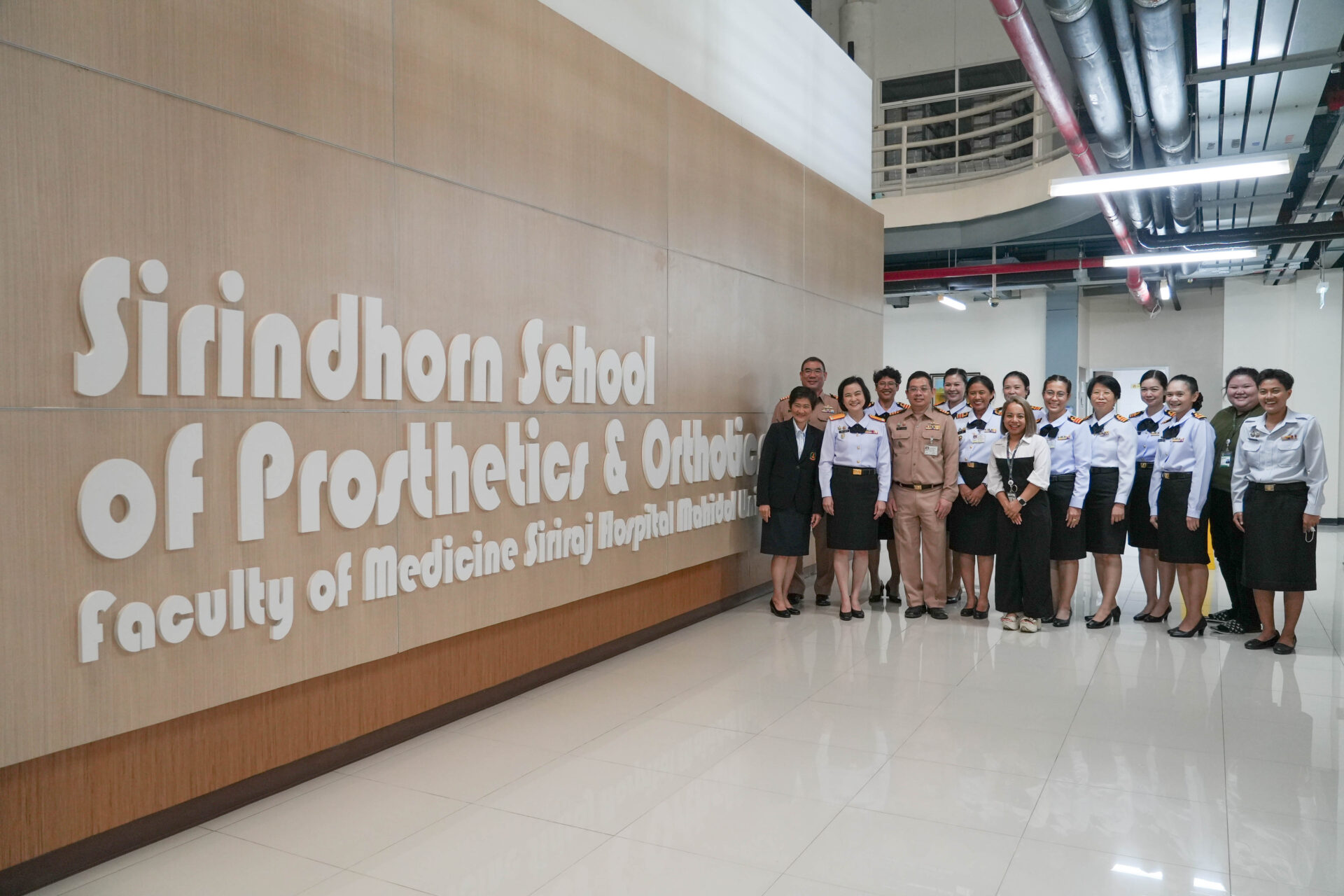
Sirindhorn School of Prosthetics and Orthotics Welcomes Delegation from the Research Promotion Office, Somdech Phra Pinklao Hospital, Royal Thai Naval Medical Department
The Prosthetics and Orthotics study visit at the Sirindhorn School of Prosthetics and Orthotics, Mahidol University, welcomed delegates from Somdech Phra Pinklao Hospital. The visit focused on clinical innovation, academic instruction, and collaborative research in prosthetics and orthotics.
Prosthetics and Orthotics Study Visit at Sirindhorn School
Overview of the Visit
On May 14, 2025, the Sirindhorn School of Prosthetics and Orthotics, Faculty of Medicine Siriraj Hospital, Mahidol University, welcomed a delegation from the Research Promotion Office of Somdech Phra Pinklao Hospital, Royal Thai Naval Medical Department. The purpose of this prosthetics and orthotics study visit was to learn more about the school’s academic, clinical, and research activities.
Assistant Professor Dr. Manunchaya Samala warmly greeted the visiting group. She gave an overview of the school’s roles and missions. Her presentation covered academic teaching, clinical service, and research efforts in prosthetics and orthotics.
Tour of Clinical Services
The group then toured the clinical service areas. Clinical instructors and prosthetists—Assistant Instructor Thana Charoenwitvorakul, Mr. Thanakorn Thammakornsuksiri, and Mr. Pasuk Samthong—provided a guided tour. They explained how the clinic supports patients in need of prosthetic and orthotic devices. In addition, they discussed the process of patient assessment and device fitting.
Afterward, the group visited the Center of Excellence for Prosthetics and Orthotics (CEPO). Mr. Apinat Jirawatthanaphan introduced the center and demonstrated advanced technologies currently in use. These innovations help improve the quality of care and device outcomes for patients.
Visit to the Research Lab
Following the clinic tour, the group explored the research laboratories. Acting Sub-Lieutenant Harit Apidet, a sports scientist, and Ms. Wisawaporn Niamsaeng, a prosthetist and research assistant, led this part of the tour. They showcased research equipment and explained how various tools are used to study mobility and improve assistive technology.
The lab’s focus is to support research that benefits people with movement impairments. Moreover, the visitors had the chance to see how research and clinical practice are closely connected.
Toward Future Collaboration
This prosthetics and orthotics study visit was a valuable opportunity for both institutions. It helped build stronger academic and research connections between the Sirindhorn School and Somdech Phra Pinklao Hospital. Moving forward, the two institutions plan to collaborate on projects that will promote research and improve patient services in Thailand’s prosthetics and orthotics field.
#SSPOResearchOffice #SSPO #Prosthetics #Orthotics #CEPO #Mahidol
More About Us
Facebook : Siriraj SSPO
Instagram : @siriraj.sspo
Website : https://www2.si.mahidol.ac.th/sspo/
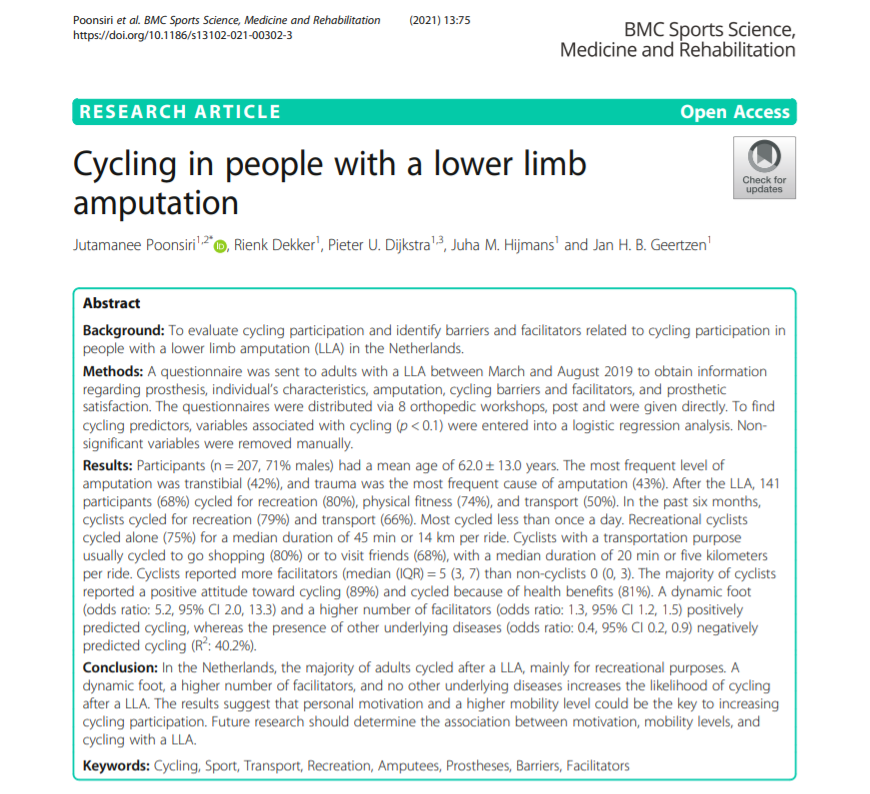
Cycling in people with a lower limb amputation – Editor’s choice collection Olympic and Paralympic Games
- Poonsiri, J., Dekker, R., Dijkstra, P. U., Hijmans, J. M., & Geertzen, J. (2021). Cycling in people with a lower limb amputation. BMC sports science, medicine & rehabilitation, 13(1), 75.
- DOI: 10.1186/s13102-021-00302-3
Abstract
Background
To evaluate cycling participation and identify barriers and facilitators related to cycling participation in people with a lower limb amputation (LLA) in the Netherlands.
Methods
A questionnaire was sent to adults with a LLA between March and August 2019 to obtain information regarding prosthesis, individual’s characteristics, amputation, cycling barriers and facilitators, and prosthetic satisfaction. The questionnaires were distributed via 8 orthopedic workshops, post and were given directly. To find cycling predictors, variables associated with cycling (p < 0.1) were entered into a logistic regression analysis. Non-significant variables were removed manually.
Results
Participants (n = 207, 71% males) had a mean age of 62.0 ± 13.0 years. The most frequent level of amputation was transtibial (42%), and trauma was the most frequent cause of amputation (43%). After the LLA, 141 participants (68%) cycled for recreation (80%), physical fitness (74%), and transport (50%). In the past six months, cyclists cycled for recreation (79%) and transport (66%). Most cycled less than once a day. Recreational cyclists cycled alone (75%) for a median duration of 45 min or 14 km per ride. Cyclists with a transportation purpose usually cycled to go shopping (80%) or to visit friends (68%), with a median duration of 20 min or five kilometers per ride. Cyclists reported more facilitators (median (IQR) = 5 (3, 7) than non-cyclists 0 (0, 3). The majority of cyclists reported a positive attitude toward cycling (89%) and cycled because of health benefits (81%). A dynamic foot (odds ratio: 5.2, 95% CI 2.0, 13.3) and a higher number of facilitators (odds ratio: 1.3, 95% CI 1.2, 1.5) positively predicted cycling, whereas the presence of other underlying diseases (odds ratio: 0.4, 95% CI 0.2, 0.9) negatively predicted cycling (R2: 40.2%).
Conclusion
In the Netherlands, the majority of adults cycled after a LLA, mainly for recreational purposes. A dynamic foot, a higher number of facilitators, and no other underlying diseases increases the likelihood of cycling after a LLA. The results suggest that personal motivation and a higher mobility level could be the key to increasing cycling participation. Future research should determine the association between motivation, mobility levels, and cycling with a LLA.
#OlympicGames #ParalympicGames 🦾
https://bmcsportsscimedrehabil.biomedcentral.com/olympics-2021
Hashtags: #Research #Thailand #siriraj #sirirajhospital #sspo #prosthetics #SirirajHospital #ProstheticsSchool #Siriraj #Mahidol #Healthcare #Rehabilitation #InternationalCooperation #Education #กายอุปกรณ์ #กายอุปกรณ์สิรินธร #โรงเรียนกายอุปกรณ์ #ศิริราช #มหิดล
Read More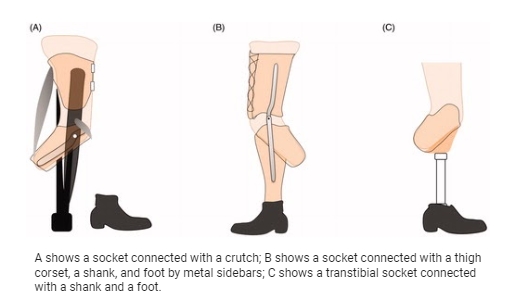
Fitting transtibial and transfemoral prostheses in persons with a severe flexion contracture: problems and solutions – a systematic review
- Jutamanee Poonsiri, Pieter U. Dijkstra & Jan H. B. Geertzen (2021) Fitting transtibial and transfemoral prostheses in persons with a severe flexion contracture: problems and solutions – a systematic review, Disability and Rehabilitation, DOI: 10.1080/09638288.2021.1893393
- DOI: 10.1080/09638288.2021.1893393
Abstract
Purpose
In persons with a hip or knee flexion contracture ≥25°, fitting a prosthesis is said to be difficult. This systematic review aims to assess the evidence for fitting of a prosthesis in persons with a severe contracture (≥25°) after a lower limb amputation.
Method
PubMed, Embase, Scopus, CINAHL, and Orthotics & Prosthetics Virtual Library databases were searched from inception to December 2019, using database specific search terms related to amputation, prosthesis, and contracture. Reference lists of included studies were checked for relevant studies. Quality of the included studies was assessed using the critical appraisal checklist for case reports (Joanna Briggs Institute).
Results
In total, 13 case studies provided evidence for fitting of a prosthesis in more than 63 persons with a transtibial amputation and three with a transfemoral amputation, all of whom had a hip or knee flexion contracture ≥25°. Some studies found a reduction in contractures after prosthesis use.
Conclusions
Several techniques for fitting a prosthesis in case of a flexion contracture ≥25° were found. Contracture reduction occurred in some cases and was possibly related to prosthesis use. Fitting a transtibial or transfemoral prosthesis in persons with a lower limb amputation with a severe flexion contracture is possible.
Hashtags: #Research #Thailand #siriraj #sirirajhospital #sspo #prosthetics #SirirajHospital #ProstheticsSchool #Siriraj #Mahidol #Healthcare #Rehabilitation #InternationalCooperation #Education #กายอุปกรณ์ #กายอุปกรณ์สิรินธร #โรงเรียนกายอุปกรณ์ #ศิริราช #มหิดล
Read More