Cycling in people with a lower limb amputation – Editor’s choice collection Olympic and Paralympic Games
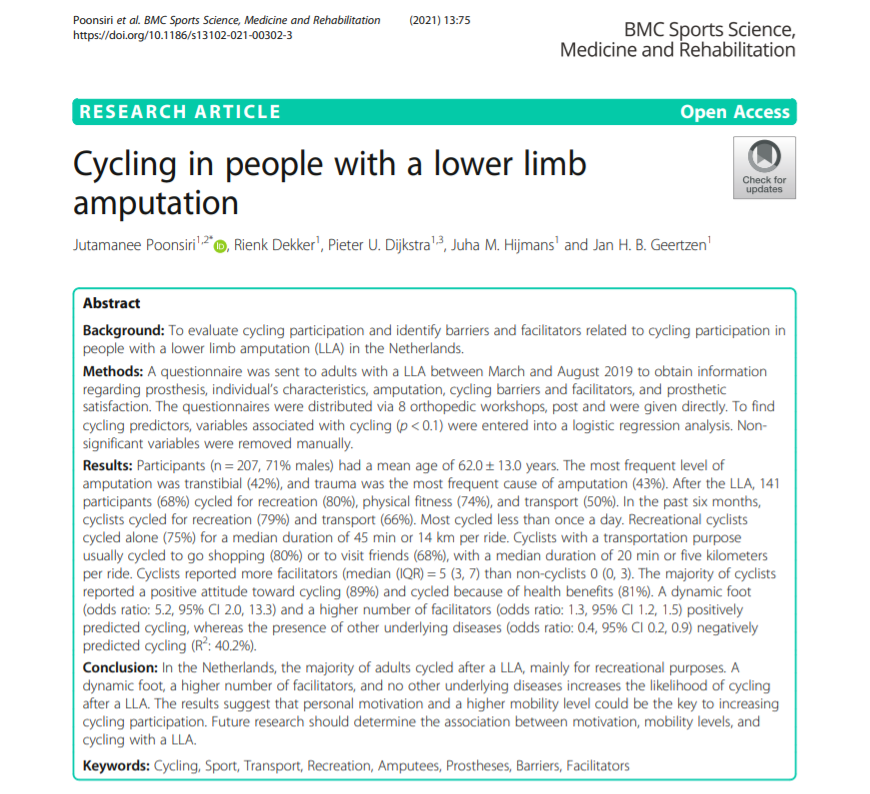
- Poonsiri, J., Dekker, R., Dijkstra, P. U., Hijmans, J. M., & Geertzen, J. (2021). Cycling in people with a lower limb amputation. BMC sports science, medicine & rehabilitation, 13(1), 75.
- DOI: 10.1186/s13102-021-00302-3
Abstract
Background
To evaluate cycling participation and identify barriers and facilitators related to cycling participation in people with a lower limb amputation (LLA) in the Netherlands.
Methods
A questionnaire was sent to adults with a LLA between March and August 2019 to obtain information regarding prosthesis, individual’s characteristics, amputation, cycling barriers and facilitators, and prosthetic satisfaction. The questionnaires were distributed via 8 orthopedic workshops, post and were given directly. To find cycling predictors, variables associated with cycling (p < 0.1) were entered into a logistic regression analysis. Non-significant variables were removed manually.
Results
Participants (n = 207, 71% males) had a mean age of 62.0 ± 13.0 years. The most frequent level of amputation was transtibial (42%), and trauma was the most frequent cause of amputation (43%). After the LLA, 141 participants (68%) cycled for recreation (80%), physical fitness (74%), and transport (50%). In the past six months, cyclists cycled for recreation (79%) and transport (66%). Most cycled less than once a day. Recreational cyclists cycled alone (75%) for a median duration of 45 min or 14 km per ride. Cyclists with a transportation purpose usually cycled to go shopping (80%) or to visit friends (68%), with a median duration of 20 min or five kilometers per ride. Cyclists reported more facilitators (median (IQR) = 5 (3, 7) than non-cyclists 0 (0, 3). The majority of cyclists reported a positive attitude toward cycling (89%) and cycled because of health benefits (81%). A dynamic foot (odds ratio: 5.2, 95% CI 2.0, 13.3) and a higher number of facilitators (odds ratio: 1.3, 95% CI 1.2, 1.5) positively predicted cycling, whereas the presence of other underlying diseases (odds ratio: 0.4, 95% CI 0.2, 0.9) negatively predicted cycling (R2: 40.2%).
Conclusion
In the Netherlands, the majority of adults cycled after a LLA, mainly for recreational purposes. A dynamic foot, a higher number of facilitators, and no other underlying diseases increases the likelihood of cycling after a LLA. The results suggest that personal motivation and a higher mobility level could be the key to increasing cycling participation. Future research should determine the association between motivation, mobility levels, and cycling with a LLA.
#OlympicGames #ParalympicGames 🦾
https://bmcsportsscimedrehabil.biomedcentral.com/olympics-2021
Hashtags: #Research #Thailand #siriraj #sirirajhospital #sspo #prosthetics #SirirajHospital #ProstheticsSchool #Siriraj #Mahidol #Healthcare #Rehabilitation #InternationalCooperation #Education #กายอุปกรณ์ #กายอุปกรณ์สิรินธร #โรงเรียนกายอุปกรณ์ #ศิริราช #มหิดล