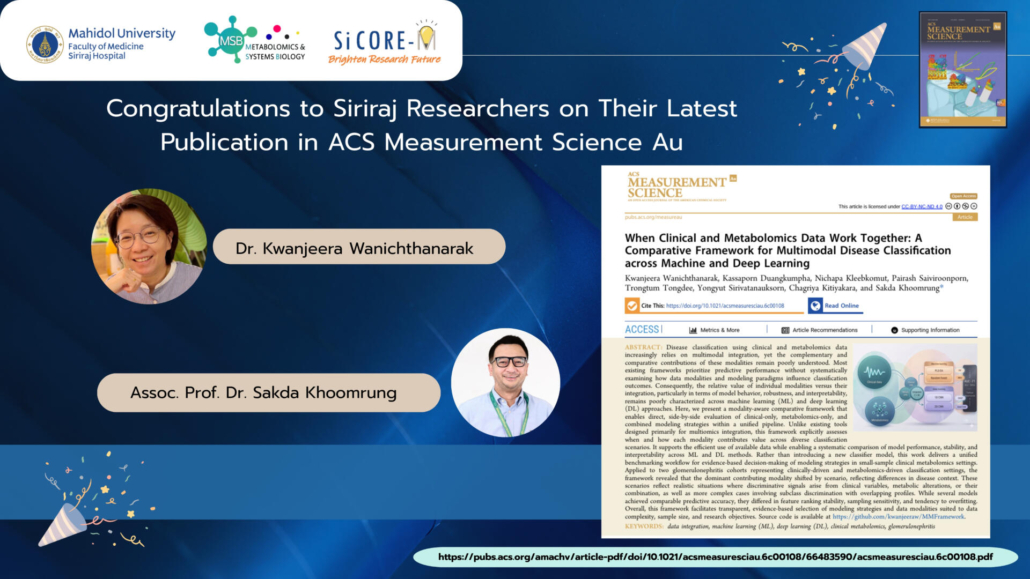


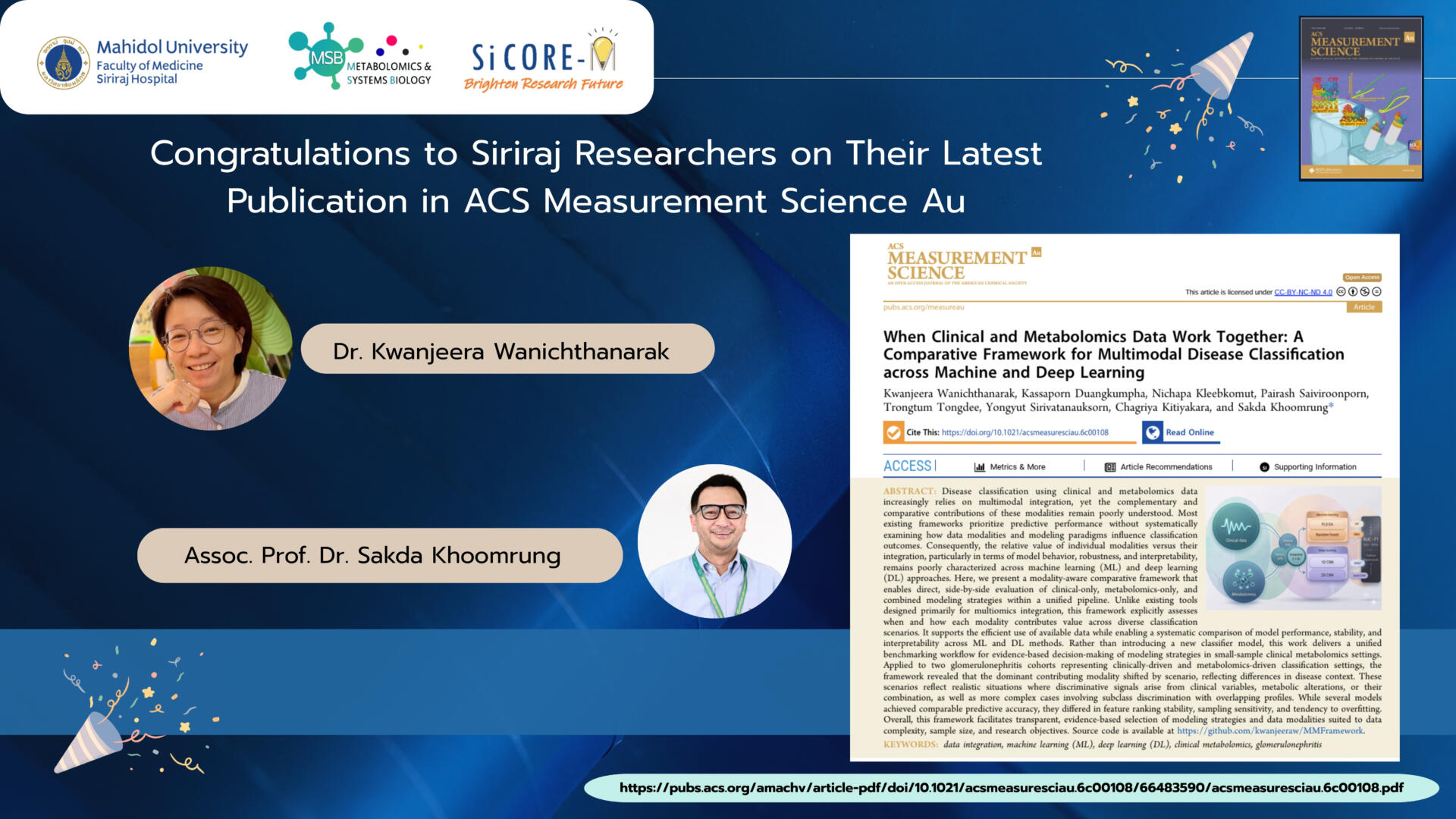
 Congratulations to Dr. Kwanjeera Wanichthanarak and Assoc. Prof. Dr. Sakda Khoomrung , Faculty of Medicine Siriraj Hospital, Mahidol University, on their latest publication in the ACS Measurement Science Au(July 22, 2026):
Congratulations to Dr. Kwanjeera Wanichthanarak and Assoc. Prof. Dr. Sakda Khoomrung , Faculty of Medicine Siriraj Hospital, Mahidol University, on their latest publication in the ACS Measurement Science Au(July 22, 2026):“When Clinical and Metabolomics Data Work Together: A Comparative Framework for Multimodal Disease Classification across Machine and Deep Learning.”
 Study Highlights
This study introduces a modality-aware comparative framework for systematically evaluating clinical-only, metabolomics-only, and integrated clinical–metabolomics data using both machine learning (ML) and deep learning (DL) approaches. The framework was applied to two glomerulonephritis cohorts representing clinically driven and metabolomics-driven classification scenarios. By comparing model performance, feature importance, stability, and overfitting across different approaches, the study demonstrates that the most informative data modality can vary depending on the disease classification task and biological context.
 Why It Matters
The findings highlight that data integration does not necessarily improve predictive performance in every classification task. Clinical data were highly informative for distinguishing lupus nephritis from healthy controls, while metabolomics contributed more strongly to distinguishing disease groups in other settings. Importantly, models with similar predictive performance could differ substantially in feature-ranking stability, sensitivity to resampling, and susceptibility to overfitting. This emphasizes the importance of evaluating not only accuracy, but also model robustness and interpretability when working with small-sample clinical metabolomics data.
 Next Steps
Future work should focus on larger and independently validated cohorts to assess the generalizability of the framework. The authors also highlight the need to explore simpler neural-network architectures and modern tabular-learning methods that may be better suited to small, structured clinical datasets. Further development could incorporate additional machine-learning models and explainable AI approaches, while addressing potential batch effects and cohort-related differences in cross-study metabolomics data.
News & Related Events