

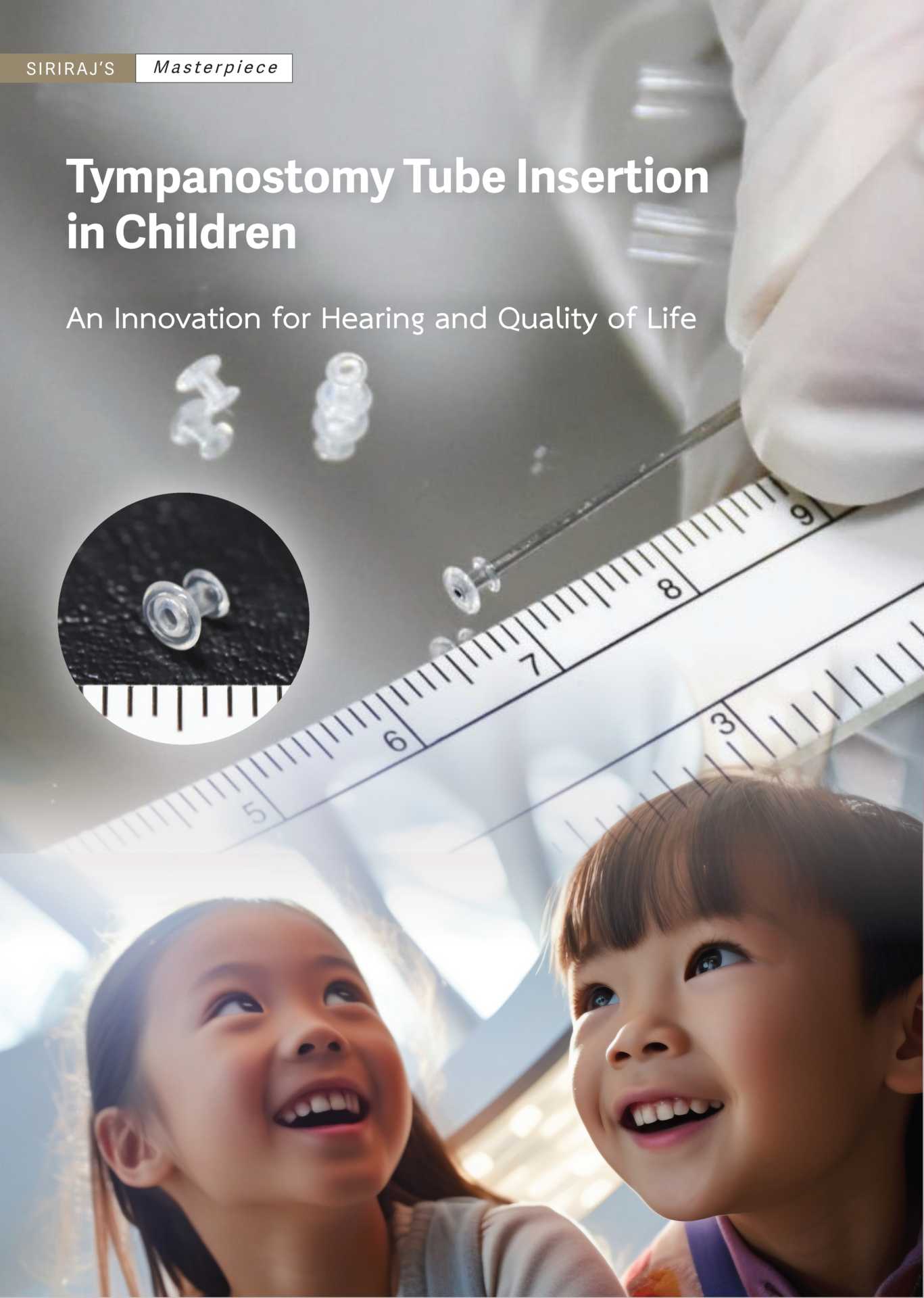
Tympanostomy Tube Insertion in Children:
An Innovation for Hearing and Quality of Life

By Assistant Professor Vannipa Vathanophas, M.D.
Department of Otorhinolaryngology, Faculty of Medicine Siriraj Hospital, Mahidol University
Chronic otitis media (COM) and otitis media with effusion (OME) are prevalent clinical problems in children, particularly those with cleft palate anomalies. These conditions significantly impair auditory acuity and language development. If left untreated, they can culminate in long-term learning deficits and a diminished quality of life.
Treatment via Tympanostomy Tube Insertion
Tympanostomy tube insertion is a universally accepted therapeutic procedure. The physician performs a myringotomy (an incision of the tympanic membrane) and inserts a micro-tube to facilitate fluid drainage and equalize middle ear pressure. Although it may appear to be a straightforward procedure, it is fundamentally an otologic microsurgery performed within a highly confined and delicate surgical field. It demands surgical proficiency, precision, and standardized instrumentation to achieve maximal safety and optimal efficacy for pediatric patients.
Tympanostomy Tube Innovation: From Manufacturing to Elevating the Quality of Life for Thai Children
The Challenges in Manufacturing Pressure Equalization (PE) Tubes Despite the critical role of tympanostomy tubes, the manufacturing of PE tubes is highly complex and capital-intensive due to:
-
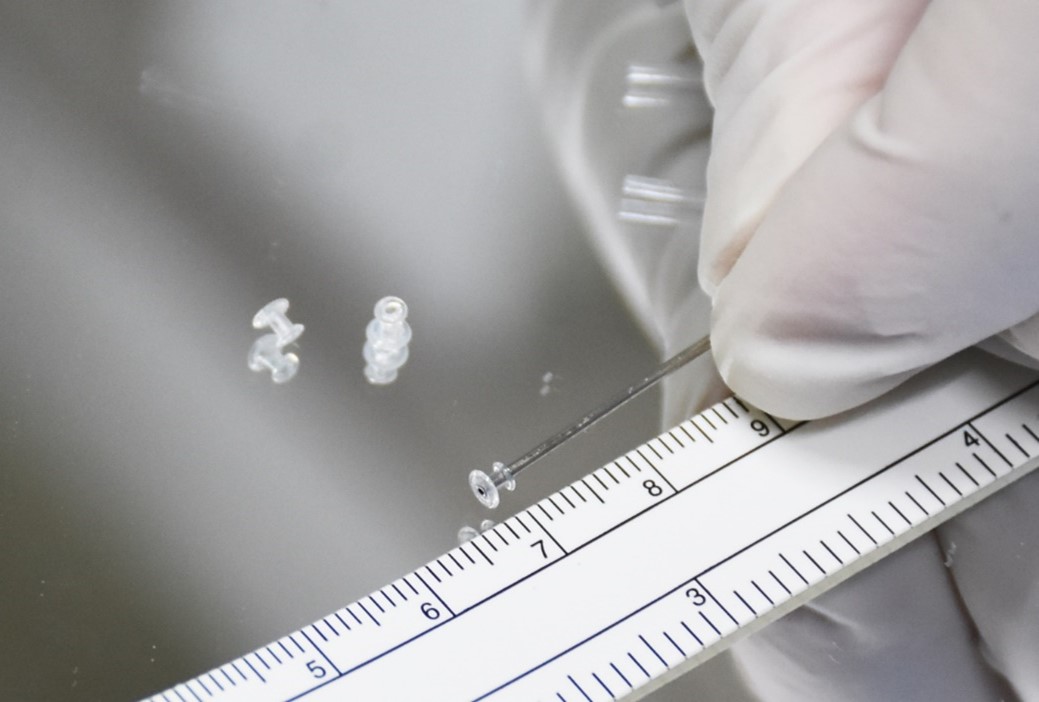
Microscopic Dimensions: With a diameter of merely a few millimeters, fabrication requires ultra-high precision molding technology.
-
Complex Manufacturing Processes: Production entails precision molding, meticulous surface smoothness inspections, and rigorous durability testing.
-
High Costs Abroad: Because they are highly specialized medical devices that are difficult to manufacture and require premium biomaterials, the market price is substantially higher than what many parents anticipate.
The PE Tube Manufacturing Process at the Department of Otorhinolaryngology, Faculty of Medicine Siriraj Hospital Local production was initiated over 30 years ago when Assistant Professor Prasit Srisomboon, MD, FICS, FACS, began utilizing medical-grade polyethylene to fabricate the Department’s proprietary PE tubes. This highly precise manufacturing process encompasses:
-
Precision Molding: To achieve the optimal dimensions and morphology.
-
Surface Inspection: Ensuring a smooth surface to minimize the accumulation of debris.
-
Durability Testing: Guaranteeing that the tube remains functional for its intended indwelling duration.
-
International Standardization: The efficacy of these tubes has been validated and published in international peer-reviewed journals.
Techniques for Fabricating PE Tubes in Resource-Limited Settings
In healthcare facilities constrained by limited resources, functional PE tubes can be manually fabricated using fundamental equipment:
-
An alcohol lamp
-
A glass slab for flanging the tube
-
A section of polyethylene tubing, 6–7 mm in length
-
A 20-gauge microsuction tube
-
A magnifying loupe for inspection
Fabrication Methodology:
-
Mount the polyethylene tube onto the tip of the microsuction.
-
Apply heat from the flame to soften the material while ensuring a central lumen forms and remains open.
-
Press the heated tip against the glass slab to flatten it into a circular shape (flange).
-
Repeat the identical process on the contralateral end.
-
Inspect the dimensional accuracy using a magnifying loupe.
Outcome: The resulting tube exhibits perfect symmetry with bilateral circular flanges, featuring standardized dimensions suitable for practical clinical application.
Domestic Pricing in Thailand
While imported PE tubes command a premium price, the Chaladkid Center at the Faculty of Medicine Siriraj Hospital distributes these proprietary tubes at a highly accessible price point of 300 THB per 3 units. This cost is significantly lower than international equivalents, yet it maintains the rigorous clinical quality that has been published and certified by international standards.
Conclusion
The innovation of Tympanostomy Tube Insertion and the local manufacturing of internationally standardized PE tubes exemplify a true medical advancement that elevates the quality of life for Thai children and their families. Despite the inherent complexities of manufacturing, the Faculty of Medicine Siriraj Hospital’s ability to distribute these devices at an accessible price ensures that a large number of children receive high-quality and safe treatment.