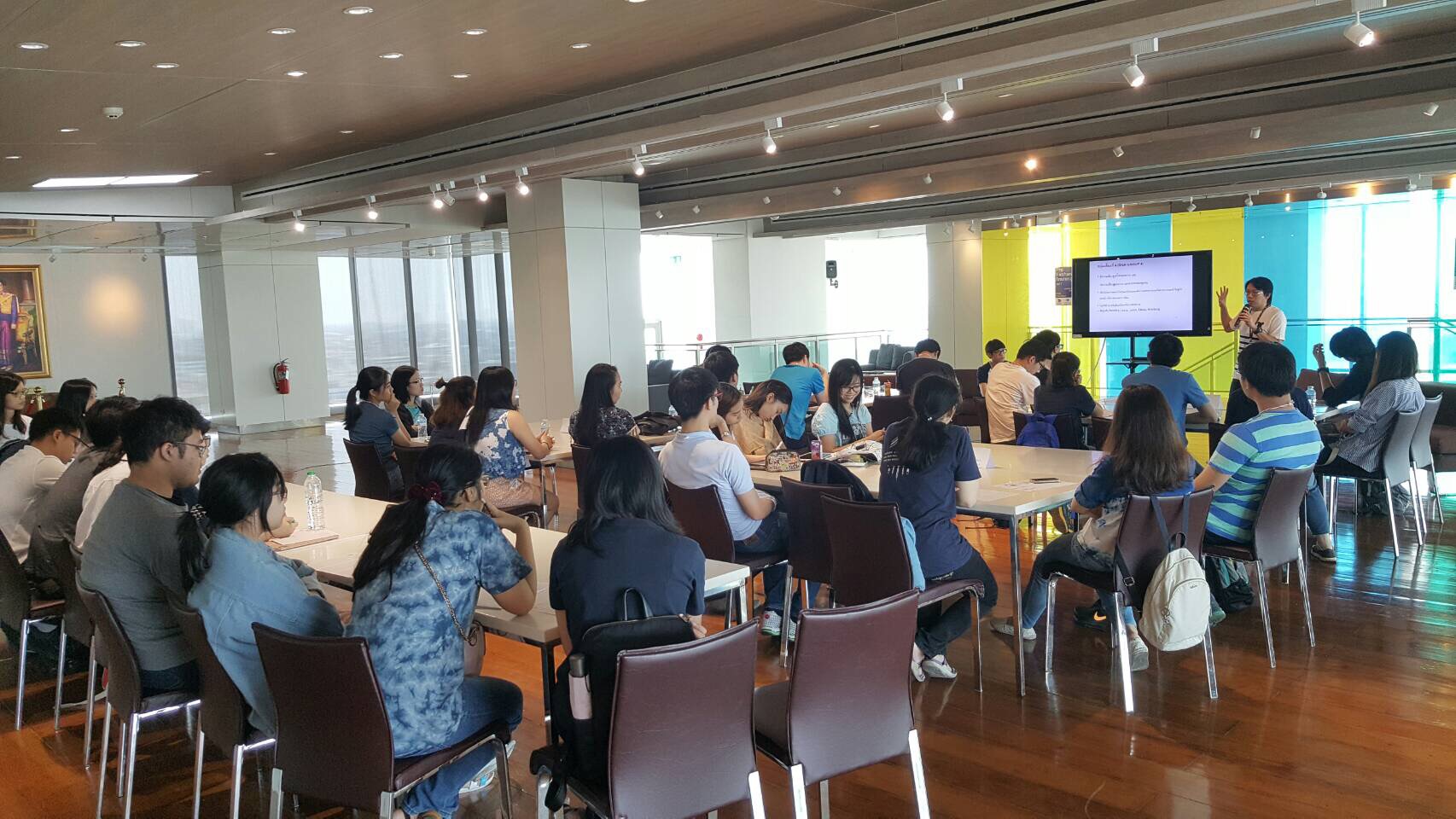
On March 12, 2017. Research division has organized activities “Pre- Exchange Training 2017” To siriraj medical students and another university medical students who study and exchange research abroad. The main objective of this training is to get ready and provide basic knowledge about how to use research tools, techniques for bring basic knowledge to apply for further research.

Faculty of Medicine Siriraj Hospital Mahidol University congratulated on winning the inventor award,

Assoc. Prof. Dr. Anchalee  Tungtrongchitr, Head of Department of Parasitology

Prof.Dr.Wanpen Chaicumpa,Consultant of Department of Parasitology

Prof.Chaweewan  Bunnag, Department of Parasitology

(the person who invention has  been patent awards ) and transfer ownership to Mahidol University annual 2016 from petty patent  No. 11485 “The process of producing allergen extract from dog and cat allergy”, by  Prof.Udom Kachintorn, President of Mahidol University has presided the awards on 2 nd March 2017 in “48 th anniversary of being royally named after him and 129 years” at  Mahidol University Salaya campus.


There are more than one million HIV patients in Thailand who require continu-ous treatment and
monitoring. Prof. Dr. Ruengpung Suthent, MD. and the Department of Microbiology, Faculty of Medicine Siriraj Hospital, have continued to study the molecular epidemiology of HIV since the discovery of the virus.

With its ongoing dedication to HIV research, the Faculty of Medicine Siriraj Hospital was first in Thailand to discover new reassortant strains of the virus and continues to have the largest collection
of HIV virus strains. As a natural outcome of Siriraj Hospital’s expertise in HIV research, the National HIV Repository and Bioinformatic Center (Thailand) was established. Its information and genetic databases have been used in the development of trial AIDS vaccines.

The center also plays a significant role in the development of virus volume and resistance monitoring in various organizations.

More information click here.

Proteomics is a new large-scale study for systematically analyzing type, quantity, and function of proteins. Proteomics has been applied in medical research to help scientists understand pathogenesis of a disease that leads to biomarkers. This makes diagnosis faster and more accurate, resulting in better treatment efficiency and less complications and may finally lead to new medicine or vaccine with greater efficiency in treatment and prevention of a disease.

In Thailand, Proteomics has been focused on proteomics of common diseases and diseases with high healthcare, economic and societal burden. The main objectives are to diagnose, treat and monitor such diseases like diabetes, kidney stone, Dengue fever, Leptospirosis, Melioidosis, Alzheimer’s disease and thalassemia.

More information click here.

Public health research continues to be an area of intense interest at Siriraj Hospital. Recent and ongoing technological advancements are focusing on proteins, antibodies, the genome, and proteomics. Given that antibiotics resistance is a developing health threat in Thailand, the Faculty of Medicine Siriraj Hospital is strengthening its efforts in the areas of genomics and alternative treatments for infectious diseases.
One of the Faculty of Medicine’s specialists who has dedicated a significant portion of her research to this area of study is Prof. Wanpen Chaikampa of the Department of Parasitology. Prof. Wanpen has more than 10 years of experience in immunology and human genes that produce antibodies that can block the virus protein production that causes influenza.

More information click here.

These services are provided by staff members who have been GCP-trained and
have clinical research skills and experience. Other services provided by the Clinical

Research Center are:
• Research feasibility study
• Proposal preparation for efficacy  assessment of all medical products
• Cost appraisal for bioequivalence study of generic formulation of drugs and phase 1 clinical trials
• Recruitment of research assistants of all levels, including research nurses, pharmacists, scientists and research project coordinators for multicenter study
• Recruitment of research participants for phase 2 to 4 clinical trials
• Research personnel training on clinical research according to the Good Clinical Research Practice (GCP)
guideline
• Coordination for collection and delivery of research samples from research participants to national and
international laboratories The Siriraj Clinical Research Center is located on the 10th floor, His Majesty the King’s 80th Birthday Anniversary 5th December 2007 Building. The SiMR is capable to provide biomedical and clinical research-related services to all research units within the Faculty of Medicine Siririaj Hospital as well as various government and private organizations.

More information click here.

The Center of Applied Thai Traditional Medicine, Faculty of Medicine Siriraj Hospital, has many responsibilities. The Center provides applied Thai traditional medicine education and related services, as well as the manufacturing of herbal medicines.

Another important responsibility is to conduct formal research and development for the purposes of advancing Thai traditional medicine and further promoting its acceptance and use among the Thai general public.

More information click here.

Globally, the prevalence oftype 2 diabetes is growing at an alarming rate around 280 million people at 2010, and then prospectively increases to 450 million people in next 20 years.

(1) Moreover, prevalence of diabetes in Thailand is around 6.9%

(2) and is projected to increase more than 46% (Western Asia Pacific) in that 20-year period.Similarly, there was an upward trend in the number of outpatient diabetes visits in Siriraj Hospital, from approximately 45,000 patients in 2011 to 51,000 patients in 2014. In addition, 12,000 new patients per year are referred to the center for diabetes and complication management from all over Thailand

(3) Consequently, diabetes will be a major problem and burden in Siriraj hospital, and will require excellent systematic diabetes service and diabetes self-management education and support and will provide many research opportunities in many aspects.

More information click here.
Over the past 30 years, the occurrence of allergies, especially respiratory allergies like asthma and allergic rhinitis, have been dramatically increasing around the world.

In Thailand, asthma is found in 15% of children and 5% of adults, with rates of allergic rhinitis as high as 40% in children and 26% in adults. Accordingly, allergies are the main cause of acute and chronic respiratory disease among Thai people.

There are currently an estimated 18 million Thai people suffering from allergies. Consistent with the scope of the prevalence, the cost of treating allergy patients is estimated to be as high as THB 2,250 million per year.

More information click here.